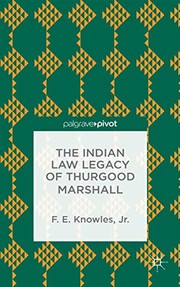
The Indian Law Legacy of Thurgood Marshall
F. Knowles · 2014
Where to buy
Amazon’s price changes daily, so the most accurate place to see it is there, at the moment you buy.
View on AmazonAbout the book
For much of the 20th century, Thurgood Marshall was a pioneer in advocacy for the disenfranchised, ground under the wheels of American Justice. In view of his activism as a law student at Howard, a protégé of Charles Houston, and then as advocate and chief counsel for the NAACP Legal Defense fund, no one can question his legitimacy as a catalyst for social justice. What then of his career on the Supreme Court? How might that passion for social justice translate in his decisions of our highest court? An examination of his published opinions in cases involving Indian law should show the extent to which that idealism matured as legal principle. This work endeavors, then, to examine 19 published Indian law decisions, dating from 1970 to 1987. Using the analytical paradigms suggested by Laurence, Hanna, and Tsosie, these decisions will be mined to expose the reasoning and logic that informed them. Some of Marshall's opinions are written for the majority, at times unanimous, but generally contentious. Others of his opinions come from his published dissents. One finds Marshall frequently at odds with Justice Powell and Justice Rehnquist. What emerges is, with rare exception, a consistency of thought and reason throughout Justice Marshall's opinions. His rationale was based on a consistent view of sovereignty, an adherence to the canon of construction in Indian law, and his view that legislative intent must be clearly articulated. Undergirding all of his work was the knowledge that American Justice had and was frequently used to promote injustice and social inequity. -- from back cover.
Book details
- Year
- 2014
- Language
- English
- Publisher
- Palgrave Pivot
- Editions
- 3
- Pages
- 84
- ISBN
- 9781137434920
Data source: Wikidata