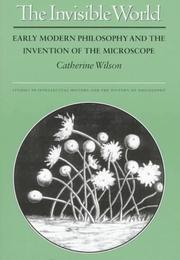
The invisible world
Catherine Wilson · 1995
Where to buy
Amazon’s price changes daily, so the most accurate place to see it is there, at the moment you buy.
View on AmazonThis is an affiliate link: if you buy through it, the site earns a small commission at no extra cost to you, which helps us bring quality content and maintain the site. As an Amazon Associate we earn from qualifying purchases.
About the book
In the seventeenth century the microscope opened up a new world of observation, and, according to Catherine Wilson, profoundly revised the thinking of scientists and philosophers alike. The interior of nature, once closed off to both sympathetic intuition and direct perception, was now accessible with the help of optical instruments. The microscope led to a conception of science as an objective, procedure-driven mode of inquiry and renewed interest in atomism and mechanism. Focusing on the earliest forays into microscopical research, from 1620 to 1720, this book provides us with both a compelling technological history and a lively assessment of the new knowledge that helped launch philosophy into the modern era. Wilson argues that the discovery of the microworld - and the apparent role of living animalcula in generation, contagion, and disease - presented metaphysicians with the task of reconciling the ubiquity of life with human-centered theological systems. It was also a source of problems for philosophers concerned with essences, qualities, and the limits of human knowledge, whose positions are echoed in current debates about realism and instrument-mediated knowledge. Covering the contributions of pioneering microscopists (Leeuwenhoek, Swammerdam, Malpighi, Grew, and Hooke) and the work of philosophers interested in the microworld (Bacon, Descartes, Leibniz, Malebranche, Locke, and Berkeley), she challenges historians who view the abstract sciences as the sole catalyst of the Scientific Revolution as she stresses the importance of observational and experimental science to the modern intellect.
First sentence: WE MIGHT AS WELL begin with what is not in dispute.
Book details
- Year
- 1995
- Language
- English
- Publisher
- Princeton University Press
- Editions
- 1
- Pages
- 296
- ISBN
- 9780691017099
Data source: Wikidata
More by Catherine Wilson