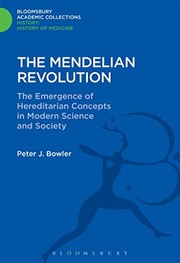
The Mendelian revolution
Peter J. Bowler · 1989
Where to buy
Amazon’s price changes daily, so the most accurate place to see it is there, at the moment you buy.
View on AmazonAbout the book
Aristotle taught that a human embryo grows from a spiritual essence provided by the father. In the eighteenth century, some thinkers imagined preformed miniatures - the entire human race, one inside the other like Russian dolls, placed by God within the womb of Eve. Even when Gregor Mendel's now-famous experiments with peas revealed the existence of what Mendel called "dominent" and "recessive" traits, other researchers ignored the findings. The history of genetics, argues Peter J. Bowler, is often a history of scientists' religious, political, and social preconceptions. In The Mendelian Revolution Bowler shows how our thinking about heredity and reproduction has changed over centuries. He describes how modern notions of heredity developed, explains what Gregor Mendel's work really meant, and challenges the myth of Mendelism's "rediscovery" in the twentieth century. From the example of genetics, he reveals the flaws in the traditional view of scientific progress as an objective search for empirical truth. And he reveals how understanding Mendelism and heredity can help us understand the increasingly complex role of genetics in the modern world. -- from dust jacket.
Book details
- Year
- 1989
- Language
- English
- Publisher
- Bloomsbury Academic
- Editions
- 1
- Pages
- 224
- ISBN
- 9781474241731
Data source: Wikidata
More by Peter J. Bowler