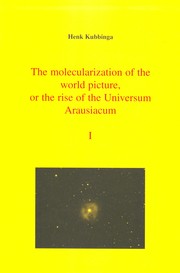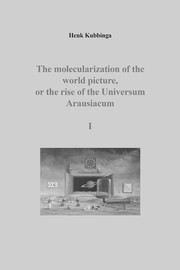
The molecularization of the world picture, or the rise of the Universum Arausiacum
Henk Kubbinga · 2022
Where to buy
Amazon’s price changes daily, so the most accurate place to see it is there, at the moment you buy.
View on AmazonAbout the book
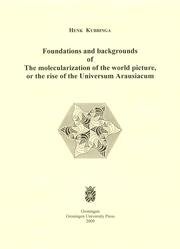
This second edition reduces to a corrected and updated version of the first edition of 2009 published by Groningen University Press. An important novelty compared to the first edition concerns the details of the calculation that led Max Planck in 1899-1900 to the introudction of a new ‘natural constant’, h, which came to be called after him. Oddly enough, not one post-1900 textbook of (Quantum) Physics gives those details; historians up till now discretely begged the question. Surprisingly, then, our sustained endeavors to follow the molecular theory in its various contexts led us to Planck’s itinarery (2000, 2018). More generally, throughout the book all historically relevant mathematics has been addressed: demonstrations of propositions (Archimedes), deductions of formulae (Clausius, Maxwell, Boltzmann, Perrin), the role of graphics – measured, calculated and/or constructed – (Andrews, Thomson, Van der Waals; Meijer, Wien, Planck), not to speak of countless chemical calculations (Dalton, Avogadro, Berzelius, Dumas, Kopp, ..). On the other hand, it can no longer surprise that the infinitesimal calculus developed in parallel with the molecular theory (Beeckman, Cavalieri, Leibniz, ..). And: Van der Waals’ equation of state reduces to an equation of the third degree. However, among the most compelling results counts the estranging way in which Einstein arrived at General Relativity: his 1911 formula doesn’t work, its outcome being ‘borrowed’ from Soldner (1801). Compared to the 2009 edition the hard core of the book remained unaltered, that is, as to the role of the molecular theory in the other sciences. It led to the cellular theory of the Life Sciences (1749; 1820) and resurfaced, later, at the level of the chromosomes (1915). In Crystallography it played a pivotal role up to the discovery of Röntgen diffraction by crystals (Laue et al. 1912). Even Philosophy got involved: Comte’s positivism derived straightforwardly from Laplace’ molecularism. Laplace’s nebular hypothesis, pure Astronomy, was on the minds of the intelligentsia all over the world. In Chemistry it produced the notion ‘mole’, one of the corner stones of the Système international [..]. Optical isomerism, in the sense of Van ‘t Hoff and Le Bel, proved crucial.
Book details
- Year
- 2022
- Publisher
- Groningen University Press
- Editions
- 1
- Pages
- 1028
- ISBN
- 9789083223100
Data source: Wikidata
More by Henk Kubbinga