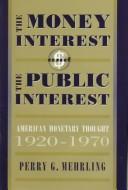
The money interest and the public interest
Perry Mehrling · 1997
Where to buy
Amazon’s price changes daily, so the most accurate place to see it is there, at the moment you buy.
View on AmazonAbout the book
The years 1920-1970 saw revolutionary change in the character of the monetary system as a consequence of depression, war, and finally prosperity. Against this background of change, Perry Mehrling tells a story of continuity around the crucial question of the role of money in American democracy, a question associated generally with the Progressive tradition and its legacy, and more particularly with the institutionalist tradition in American economic thought. In this story, which he tells through the ideas and lives of three prominent institutionalists, Allyn Young, Alvin Hansen, and Edward Shaw, progress is measured not by the swings of fashion between two polar traditions of monetary thought - quantity theory and anti-quantity theory - but rather by the success with which each succeeding generation finds its footing on the shifting middle ground between the two extremes. More than a simple history of monetary doctrine, the book makes a case for the continuing influence of a distinctly American tradition on the evolution of economic thought in general. In this tradition, monetary and financial institutions are shaped by historical forces and adapt to the changing needs of the economy.
Book details
- Year
- 1997
- Language
- English
- Publisher
- Harvard University Press
- Editions
- 2
- Pages
- 288
- ISBN
- 9780674584303
Data source: Wikidata