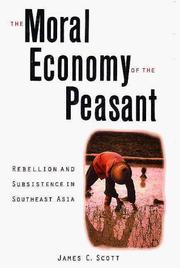
The moral economy of the peasant
James C. Scott · 1976
Where to buy
Amazon’s price changes daily, so the most accurate place to see it is there, at the moment you buy.
View on AmazonAbout the book
"James C. Scott places the critical problem of the peasant household -- subsistence -- at the center of this study. The fear of food shortages, he argues persuasively, explains many otherwise puzzling technical, social, and moral arrangements in peasant society, such as resistance to innovation, the desire to own land even at some cost in terms of income, relationships with other people, and relationships with institutions, including the state. Once the centrality of the subsistence problem is recognized, its effects on notions of economic and political justice can also be seen. Scott draws from the history of agrarian society in lower Burma and Vietnam to show how the transformations of the colonial era systematically violated the peasants' 'moral economy' and created a situation of potential rebellion and revolution. Demonstrating keen insights into the behavior of people in other cultures and a rare ability to generalize soundly from case studies, Scott offers a different perspective on peasant behavior that will be of interest particularly to political scientists, anthropologists, sociologists, and Southeast Asianists."--Publisher description.
First sentence: The distinctive economic behavior of the subsistence-oriented peasant family results from the fact that, unlike a capitalist enterprise, it is a unit of consumption as well as a unit of production.
Book details
- Year
- 1976
- Language
- English
- Publisher
- Yale University Press
- Editions
- 4
- Pages
- 254
- ISBN
- 9780300021905
Data source: Wikidata
More by James C. Scott