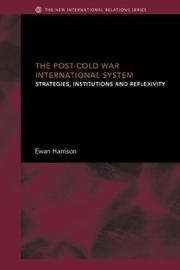
The Post-Cold War International System
Ewan Harrison · 2006
Where to buy
Amazon’s price changes daily, so the most accurate place to see it is there, at the moment you buy.
View on AmazonThis is an affiliate link: if you buy through it, the site earns a small commission at no extra cost to you, which helps us bring quality content and maintain the site. As an Amazon Associate we earn from qualifying purchases.
About the book
"The end of the Cold War has opened up a 'real world laboratory' in which to test and refine general theories of international relations. Using the frameworks provided by structural realism, institutionalism and liberalism, The Post-Cold War International System examines how major powers responded to the collapse of the Soviet Union and developed their foreign policies over the period of post-Cold War transition." "This book argues that the democratic peace has begun to generate powerful socialization effects, due to the emergence of a critical mass of liberal democratic states since the end of the Cold War. The trend this has produced is similar to a pattern that classical realists have interpreted as 'bandwagoning' within a unipolar power structure. Case studies of Germany, China and Japan - identified as key states with the potential to challenge US dominance - provide evidence to support the assessment of international change. The author concludes by exploring the implications of September 11 for the analysis developed." "This important volume argues that the end of the Cold War was a major historical turning point in the development of world politics with fundamental implications for the basic way in which the dynamics of the international system are conceptualized. It will interest all students and researchers of international politics."--BOOK JACKET.
Book details
- Year
- 2006
- Language
- English
- Publisher
- Routledge
- Editions
- 1
- ISBN
- 9780415429740
Data source: Wikidata