The Riemann hypothesis
Peter B. Borwein · 2007
Where to buy
Amazon’s price changes daily, so the most accurate place to see it is there, at the moment you buy.
View on AmazonThis is an affiliate link: if you buy through it, the site earns a small commission at no extra cost to you, which helps us bring quality content and maintain the site. As an Amazon Associate we earn from qualifying purchases.
About the book
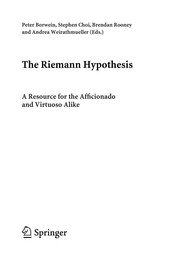
The Riemann Hypothesis has become the Holy Grail of mathematics in the century and a half since 1859 when Bernhard Riemann, one of the extraordinary mathematical talents of the 19th century, originally posed the problem. While the problem is notoriously difficult, and complicated even to state carefully, it can be loosely formulated as "the number of integers with an even number of prime factors is the same as the number of integers with an odd number of prime factors." The Hypothesis makes a very precise connection between two seemingly unrelated mathematical objects, namely prime numbers and the zeros of analytic functions. If solved, it would give us profound insight into number theory and, in particular, the nature of prime numbers. This book is an introduction to the theory surrounding the Riemann Hypothesis. Part I serves as a compendium of known results and as a primer for the material presented in the 20 original papers contained in Part II. The original papers place the material into historical context and illustrate the motivations for research on and around the Riemann Hypothesis. Several of these papers focus on computation of the zeta function, while others give proofs of the Prime Number Theorem, since the Prime Number Theorem is so closely connected to the Riemann Hypothesis. The text is suitable for a graduate course or seminar or simply as a reference for anyone interested in this extraordinary conjecture.
Book details
- Year
- 2007
- Language
- English
- Publisher
- Springer
- Editions
- 2
- Pages
- 588
- ISBN
- 9780387721255
Data source: Wikidata
More by Peter B. Borwein