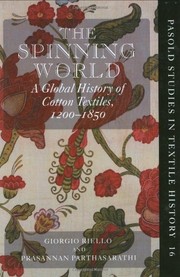
The spinning world
Where to buy
Amazon’s price changes daily, so the most accurate place to see it is there, at the moment you buy.
View on AmazonThis is an affiliate link: if you buy through it, the site earns a small commission at no extra cost to you, which helps us bring quality content and maintain the site. As an Amazon Associate we earn from qualifying purchases.
About the book
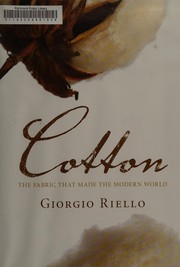
Cotton textiles were the first good to achieve a truly global reach. For many centuries muslins and calicoes from the Indian subcontinent were demanded in the trading worlds of the Indian Ocean and the eastern Mediterranean. After 1500, new circuits of exchange were developed. Of these, the early-modern European craze for Indian calicoes and the huge nineteenth-century export trade in Lancashire goods, and subsequent deindustrialization of the Indian subcontinent, are merely thebest known. These episodes, although of great importance, far from exhaust the story of cotton. They are well known because of the enormous research energy that has been devoted to them, but other important elements of cotton's long history are deserving of similar attention. The purpose of this collection of essays is to examine the history of cotton textiles at a global level over the period 1200-1850.^ This volume provides new answers to two questions: what is it about cotton that made it the paradigmatic first global commodity? And second, why did cotton industries in different parts of the world follow different paths of development? Included in this second question is, of course, the problem of the so-called 'great divergence' that suggests that Europe and Asia followed a common path of economic development until the end of the eighteenth century. Cotton textiles have been central in explaining the nature, timing and effects of a 'divergence' in the nineteenth. A volume of this sort is timely for many reasons, not least of which is the growing interest in global history. Textiles remain one of the most important manufactured commodities in debates about economic, social and cultural change across the globe.^ By adopting a long historical view and a broad geographical viewpoint, this book wishes to avoid a Eurocentric perspective that has long dominated debates over the birth and rise of the cotton textiles industry in Europe. Empirically this book brings together, and adds to, the current state of knowledge on a number of questions related to the history of cotton textiles. The outlines of the cotton industry in medieval and early modern times, whether in southern Europe, central Africa, west Asia or the Indian subcontinent, are known only in the sketchiest of terms. The relationship between cotton textiles and those made from other fibres such as wool, linen, and silk is poorly understood. And there has been awoeful neglect of the cloth made from the great mixtures of cotton
Book details
- Year
- 2009
- Language
- English
- Series
- Pasold studies in textile history -- 16
- Publisher
- Oxford University Press
- Editions
- 4
- Pages
- 489
- ISBN
- 9780199559442
Data source: Wikidata
More by Giorgio Riello