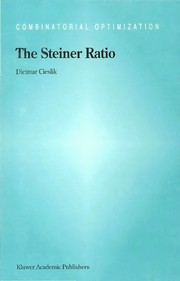
The Steiner ratio
Dietmar Cieslik · 2001
Where to buy
Amazon’s price changes daily, so the most accurate place to see it is there, at the moment you buy.
View on AmazonThis is an affiliate link: if you buy through it, the site earns a small commission at no extra cost to you, which helps us bring quality content and maintain the site. As an Amazon Associate we earn from qualifying purchases.
About the book
Steiner's Problem concerns finding a shortest interconnecting network for a finite set of points in a metric space. A solution must be a tree, which is called a Steiner Minimal Tree (SMT), and may contain vertices different from the points which are to be connected. Steiner's Problem is one of the most famous combinatorial-geometrical problems, but unfortunately it is very difficult in terms of combinatorial structure as well as computational complexity. However, if only a Minimum Spanning Tree (MST) without additional vertices in the interconnecting network is sought, then it is simple to solve. So it is of interest to know what the error is if an MST is constructed instead of an SMT. The worst case for this ratio running over all finite sets is called the Steiner ratio of the space. The book concentrates on investigating the Steiner ratio. The goal is to determine, or at least estimate, the Steiner ratio for many different metric spaces. The author shows that the description of the Steiner ratio contains many questions from geometry, optimization, and graph theory. Audience: Researchers in network design, applied optimization, and design of algorithms.
Book details
- Year
- 2001
- Language
- English
- Publisher
- Springer London, Limited
- Editions
- 4
- ISBN
- 9781475767988
Data source: Wikidata
More by Dietmar Cieslik