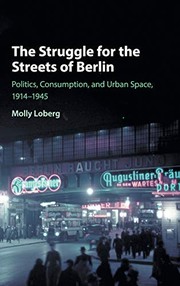
The Struggle for the Streets of Berlin: Politics, Consumption, and Urban Space, 1914-1945
Molly Loberg · 2018
Where to buy
Amazon’s price changes daily, so the most accurate place to see it is there, at the moment you buy.
View on AmazonAbout the book
Who owns the street? Interwar Berliners faced this question with great hope yet devastating consequences. In Germany, the First World War and 1918 Revolution transformed the city streets into the most important media for politics and commerce. There, partisans and entrepreneurs fought for the attention of crowds with posters, illuminated advertisements, parades, traffic jams, and violence. The Nazi Party relied on how people already experienced the city to stage aggressive political theater, including the April Boycott and Kristallnacht. Observers in Germany and abroad looked to Berlin's streets to predict the future. They saw dazzling window displays that radiated optimism. They also witnessed crime waves, antisemitic rioting, and failed policing that pointed toward societal collapse. Recognizing the power of urban space, officials pursued increasingly radical policies to 'revitalize' the city, culminating in Albert Speer's plan to eradicate the heart of Berlin and build Germania.
Book details
- Year
- 2018
- Language
- English
- Publisher
- Cambridge University Press
- Editions
- 1
- Pages
- 338
- ISBN
- 9781108417648
Data source: Wikidata