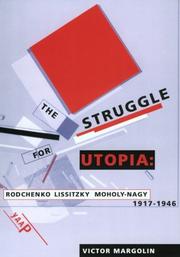
The Struggle for Utopia
Victor Margolin · 1997
Where to buy
Amazon’s price changes daily, so the most accurate place to see it is there, at the moment you buy.
View on AmazonThis is an affiliate link: if you buy through it, the site earns a small commission at no extra cost to you, which helps us bring quality content and maintain the site. As an Amazon Associate we earn from qualifying purchases.
About the book
Following World War I, a new artistic-social avant-garde emerged with the ambition to engage the artist in the building of social life. Nowhere is this project more evident than in the lives of Alexander Rodchenko, El Lissitzky, and Laszlo Moholy-Nagy whose careers covered a broad range of artistic practices and political situations. The remarkable continuity between the various forms of their work stems from their belief that art had to be extended beyond the aesthetic sphere. But given that the social situations they confronted changed radically in their lifetimes, their operative strategies were severely tested and underwent significant revisions. Through close readings of their work as it relates to the situations in which they were active, Victor Margolin examines the way these three artists negotiated the changing relations between their social ideals and the political realities they confronted. He follows them and their affiliations through the 1920s and 1930s in Moscow, Berlin, and Chicago, documenting their contributions to utopian architecture, Constructivist ideology, industrial design, photography, visual communication, and design education. Each essay features one or two of the artist-designers and shifts from one medium to another through a chronological narrative that begins with the Bolshevik Revolution in Russia and ends in Chicago just after World War II. Focusing on the difficult relationship between art and social change, Margolin brings important new insights to our understanding of the avant-garde's role in a period of great political complexity.
First sentence: The utopian imagination-a means to envision new possibilities for human life-was particularly strong at the time of the Russian Revolution in 1917 when the opportunity arose to transform an entire nation.
Book details
- Year
- 1997
- Language
- English
- Publisher
- University Of Chicago Press
- Editions
- 1
- Pages
- 276
- ISBN
- 9780226505169
Data source: Wikidata
More by Victor Margolin