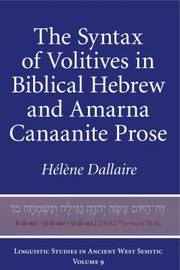
The syntax of volitives in biblical Hebrew and Amarna Canaanite prose
Hélène Dallaire · 2014
Where to buy
Amazon’s price changes daily, so the most accurate place to see it is there, at the moment you buy.
View on AmazonAbout the book
"During the past century, numerous books and articles have appeared on the verbal system of Semitic languages. Thanks to the discovery of Ugaritic texts, Akkadian tablets, Canaanite letters found at Tell el-Amarna in Egypt, Hebrew and Aramaic inscriptions, and the Dead Sea Scrolls, our understanding of the phonology, morphology, and syntax of the Semitic languages has increased substantially. Dallaire focuses primarily on prose texts in Biblical Hebrew and Amarna Canaanite in which the verbal system (morphemes, syntax) expresses nuances of wishes, desires, requests, and commands. According to her, volitional concepts are found in every language and are expressed through verbal morphemes, syntagmas, intonation, syntax, and other linguistic means. The Syntax of Volitives in biblical Hebrew and Amarna Canaanite prose attempts to answer the following questions: do volitives function in a similar way in biblical Hebrew and Amarna Canaanite? Where and why is there overlap in morphology and syntax between these two languages? What morphological and syntactical differences exist between the volitional expressions of the languages? In attempting to answer these questions, the author bears in mind the fact that, within each of these two languages, scribes from different areas used specific dialectal and scribal traditions (for example, northern versus southern, peripheral versus central)"--
Book details
- Year
- 2014
- Language
- English
- Series
- Linguistic studies in Ancient West Semitic -- 9
- Publisher
- Eisenbrauns
- Editions
- 1
- Pages
- 250
- ISBN
- 9781575063072
Data source: Wikidata