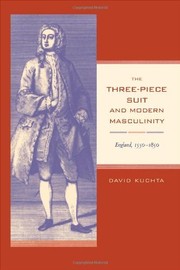
The Three-Piece Suit and Modern Masculinity
David Kuchta · 2002
Where to buy
Amazon’s price changes daily, so the most accurate place to see it is there, at the moment you buy.
View on AmazonAbout the book
"How one defined consumption - especially the distinction between healthy consumption and unhealthy luxury - depended on one's status and views. Kuchta analyzes men's clothing consumption under three different political and cultural regimes: Tudor-Stuart court culture, eighteenth-century aristocratic society, and early Victorian middle-class culture. With the adoption of the three-piece suit, elite masculinity rejected the idea of sumptuous display as the privilege of nobility and regarded fashion instead as the concern of debauched upstarts. Anyone who did not subscribe to this ideology of renunciation could be presumed guilty of "luxury" and "effeminacy." There have, of course, been numerous exceptions, not to mention visible resistance, to the general trend toward simplicity, but the modest three-piece suit has remained the emblem of English manliness.". "Kuchta shows not only how the ideology of modern English masculinity was a self-consciously political and public creation but also how such explicitly political decisions and values became internalized, personalized, and naturalized into everyday manners and habits. The three-piece suit, a fashion statement so successful that it ceased to be noticed, is now back in the spotlight."--BOOK JACKET.
First sentence: As history records it, October 7, 1666 marks the beginning of the three-piece suit, for it was on this day, according to Samuel Pepys's Diary, that England's King Charles II declared his resolution of setting a fashion for clothes, which he will never alter.
Book details
- Year
- 2002
- Language
- English
- Publisher
- University of California Press
- Editions
- 3
- Pages
- 336
- ISBN
- 9780520214934
Data source: Wikidata