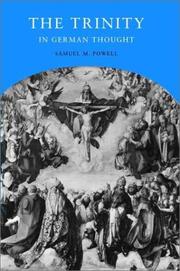
The Trinity in German Thought
Samuel M. Powell · 2001
Where to buy
Amazon’s price changes daily, so the most accurate place to see it is there, at the moment you buy.
View on AmazonThis is an affiliate link: if you buy through it, the site earns a small commission at no extra cost to you, which helps us bring quality content and maintain the site. As an Amazon Associate we earn from qualifying purchases.
About the book
"The Trinity in German Thought describes the three ideas that govern modern German Trinitarian thought: the ideas of reflective selfhood, of revelation, and of history. "Reflective selfhood" designates the attempt at finding an analogy between the Trinity and the structure of the human self. Such attempts, following the lead of Augustine, typically see the structure of self-consciousness as an especially apt analogy of the Trinity. "Revelation" points to two questions: what is the Word of God? and can the idea of the Trinity be derived from the Word? From Martin Luther to the present, Trinitarian thought has depended on the way in which theologians conceived of the Word. "History" designates the impact that historical modes of thought have had on Trinitarian thought. For some, "history" has meant a critical approach to Scripture and creeds; for others, it has meant God's own participation in history."--Jacket.
Book details
- Year
- 2001
- Language
- English
- Publisher
- Cambridge University Press
- Editions
- 5
- Pages
- 288
- ISBN
- 9780521781961
Data source: Wikidata
More by Samuel M. Powell