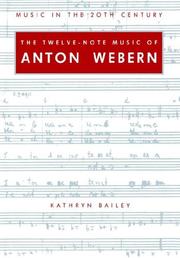
The twelve-note music of Anton Webern
Kathryn Bailey, Bailey, Kathryn Dr · 1991
Where to buy
Amazon’s price changes daily, so the most accurate place to see it is there, at the moment you buy.
View on AmazonAbout the book
"This important study reassesses the position of Anton Webern in twentieth-century music. The twelve-note method of composition introduced by Arnold Schoenberg in the 1920s was one of the most important musical innovations of the century. Its adoption by his pupil Anton Webern had profound consequences for composers of the next generation such as Stockhausen and Boulez, who saw Webern's music as revolutionary. In her detailed analyses, however, Professor Bailey demonstrates a fundamentally traditional aspect to Webern's creativity, particularly in his continued use of classical forms such as sonata, rondo, theme and variations, etc., and in his consistent use of traditional language and concepts when describing his own music. Professor Bailey analyses all Webern's twelve-note works (from Op. 17 to Op. 31), i.e. the instrumental and vocal music written between 1924 and 1943. These analyses draw on sketch material recently made available at the Paul Sacher Foundation in Basel and include transcriptions of little-known drafts and sketches. A valuable aspect of the book is the inclusion in appendices of such materials as a complete explanation of the row content of each work, the correct prime form of each of the rows from Op. 20 onwards, with a matrix constructed for each, and exhaustive row analyses."--Publisher description.
Book details
- Year
- 1991
- Language
- English
- Publisher
- Cambridge University Press
- Editions
- 3
- Pages
- 474
- ISBN
- 9780521547963
Data source: Wikidata