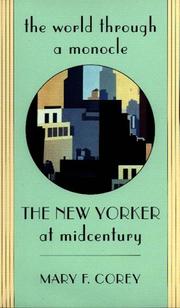
The world through a monocle
Mary F. Corey · 1999
Where to buy
Amazon’s price changes daily, so the most accurate place to see it is there, at the moment you buy.
View on AmazonThis is an affiliate link: if you buy through it, the site earns a small commission at no extra cost to you, which helps us bring quality content and maintain the site. As an Amazon Associate we earn from qualifying purchases.
About the book
At midcentury, The New Yorker magazine occupied an unsurpassed niche of cultural authority, wielding a power without precedent in the magazine market. In this period a small but influential community of readers relied on The New Yorker as a guide to the emerging postwar world, turning to it for information about Broadway theater, Parisian pret-a-porter, Italian Communism, the bombing of Bikini Atoll, English movies, and French wines. A well-known critic lamented that "certain groups have come to communicate almost exclusively in references to the [magazine's] sacred writings." The World through a Monocle is a study of these "sacred writings.". Mary Corey mines the magazine's mix of journalism, fiction, advertisements, cartoons, and poetry to unearth a kind of New Yorker Village - a locale of contradiction and delight, of self-importance and social justice. She exposes a magazine with blind spots in regard to women and to racial and ethnic stereotyping, but which nevertheless strove towards liberal ideals, publishing the work of Rachel Carson, John Hersey, Hannah Arendt, and others. She recreates an audience that devoured ads for luxury items while avidly absorbing social criticism and political engagement. Balancing the wish to live well with the aim to do good, The New Yorker provided what seemed like a coherent value system in an incoherent world.
Book details
- Year
- 1999
- Language
- English
- Publisher
- Harvard University Press
- Editions
- 1
- Pages
- 272
- ISBN
- 9780674002081
Data source: Wikidata