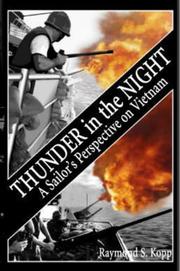
Thunder in the Night
Raymond S. Kopp · 2004
Where to buy
Amazon’s price changes daily, so the most accurate place to see it is there, at the moment you buy.
View on AmazonThis is an affiliate link: if you buy through it, the site earns a small commission at no extra cost to you, which helps us bring quality content and maintain the site. As an Amazon Associate we earn from qualifying purchases.
About the book
Written by Bernie Weisz, Vietnam Historian September 18th, 2010 Pembroke Pines, Florida contact: [email protected] E mail: [email protected] Title of Review: "In The Navy of the "4th Reich To Return To an Unappreciative Nation!" To understand Ray Kopp's book "Thunder in the Night", a brief overview of events in S.E. Asia must be mentioned. After the 1968 infamous "Tet Offensive", American involvement was doomed. To quickly recap what happened,onJanuary 21, 1968, a shattering barrage of shells, mortars and rockets slam into the Marine base at Khe Sanh. Eighteen Marines were killed instantly, 40 were wounded. The initial attack continued for two days. this was only a prelude, as on January 30 - 31, 1968, which was the Vietnamese "New Year" known as the Tet holiday, Vietcong units fanned out all over supposedly safe and secure South Vietnam. In more than 100 cities and towns, shock attacks by Vietcong sappers and suicide bent commandos were followed by wave after wave of supporting troops. When the battles for the cities of South Vietnam ended, 37,000 Vietcong troops had been killed. Many more had been wounded or captured, and the fighting had created more than a half million civilian refugees. Casualties included most of the Vietcong's best fighters, political officers and secret organizers. Incongruously, for North Vietnam, Tet was nothing less than a catastrophe. But for the Americans, who lost 2,500 men, it was a serious blow to public support. Walter Cronkite pronounced on national television that the Tet offensive was a “defeat” for America and his announcement was widely credited as a turning point in American support for the war. In a famous half-hour news special, he declared that in the aftermath of Tet “it seems now more certain than ever that the bloody experience of Vietnam is to end in a stalemate.” Lyndon Johnson was reported to be dismayed at the prospect of losing Cronkite’s support for the war. And indeed, public support for the war dropped 25% following Cronkite’s declaration and media coverage of the offensive in general. In 1969, President Richard M. Nixon took office as the new U.S. President, replacing L.B.J. . He promised to achieve in Vietnam "Peace With Honor." The plan was to negotiate a settlement with the North Vietnamese, enabling the half million U.S. troops to be withdrawn while simultaneously keeping the corrupt and incompetent South Vietnamese government in power. Nixon's plans looked admirable, but the war rolled on. He author
Book details
- Year
- 2004
- Language
- English
- Publisher
- Brundage Pub.
- Editions
- 1
- Pages
- 179
- ISBN
- 9781892451286
Data source: Wikidata