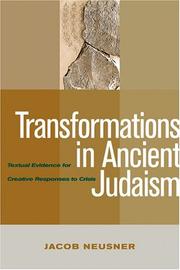
Transformations In Ancient Judaism
Jacob Neusner · 2004
Where to buy
Amazon’s price changes daily, so the most accurate place to see it is there, at the moment you buy.
View on AmazonThis is an affiliate link: if you buy through it, the site earns a small commission at no extra cost to you, which helps us bring quality content and maintain the site. As an Amazon Associate we earn from qualifying purchases.
About the book
"The Jewish people endured three crises during the formation of what would become the Jewish canon, and these significantly shaped their religion. The destruction of Solomon's Temple by Nebuchadnezzar in 586 B.C.E., the destruction of Herod's Temple by the Romans in 70 C.E., and the acceptance of Christianity as the state religion of Rome in 363 C.E. each signaled the apparent end of Jewish religion. Instead of succumbing to defeat and despair, Judaism arose, transformed and strengthened, from each crisis as a result of its religious leaders' reinterpretation of its sacred texts." "In Transformations, Jacob Neusner reasons that the Jewish canonical writings - the Hebrew Bible, Mishnah, Talmuds, and Midrash - illustrate Judaism's response to these three social, cultural, and political crises. Faced with these catastrophic events, the Rabbinic sages explored anew the paradigms of piety and practice which they had received from previous generations. The result was that they discovered a truth both continuous with the past and responsive to the unanticipated crisis - a truth that carved out a path for the future. This process, represented in the Jewish canon, continues to define modern Judaism. Jacob Neusner's thesis is this: When faced with defeat, Judaism reaches a turning point and, in an act of stubborn affirmation, Judaism is transformed."--BOOK JACKET.
Book details
- Year
- 2004
- Language
- English
- Publisher
- Hendrickson Publishers
- Editions
- 1
- Pages
- 180
- ISBN
- 9781565637054
Data source: Wikidata
More by Jacob Neusner