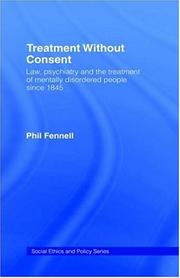
Treatment without consent
Phil Fennell · 1995
Where to buy
Amazon’s price changes daily, so the most accurate place to see it is there, at the moment you buy.
View on AmazonThis is an affiliate link: if you buy through it, the site earns a small commission at no extra cost to you, which helps us bring quality content and maintain the site. As an Amazon Associate we earn from qualifying purchases.
About the book
Phil Fennell's study traces the history of the treatment of mental disorder in Britain over the last 150 years. It focuses specifically on treatment without consent, analysing the provisions of legislation under which it has been authorised. This book examines the range of different forms which treatment interventions have taken: physical and mechanical restraint, seclusion, routine and emergency chemical sedation, force feeding, psychosurgery and shock therapy. Controversial aspects of present-day treatments, like Electro Convulsive Therapy and neuroleptic medication, are examined, and the vexed issue of sterilisation of people with learning disabilities is discussed. Phil Fennell investigates the way perceptions of consent have changed over the period. He shows how, well into the second half of this century, it was widely believed that relatives could consent to the treatment of a mentally disordered person. This contrasts with present-day statutory and common law rules, and the recommendations of the Law Commission for a new legal regime to cover the treatment of people without mental capacity.
First sentence: We are currently in an era, which effectively began in the 1960s, when consent to treatment is probably the central issue both in bioethics, and the growing speciality of medical law.
Book details
- Year
- 1995
- Language
- English
- Publisher
- Routledge
- Editions
- 7
- Pages
- 368
- ISBN
- 9780415077873
Data source: Wikidata
More by Phil Fennell