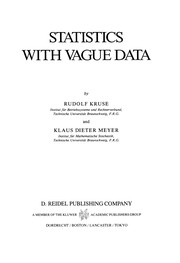
Uncertainty and Vagueness in Knowledge Based Systems
Rudolf Kruse · 1991
Where to buy
Amazon’s price changes daily, so the most accurate place to see it is there, at the moment you buy.
View on AmazonThis is an affiliate link: if you buy through it, the site earns a small commission at no extra cost to you, which helps us bring quality content and maintain the site. As an Amazon Associate we earn from qualifying purchases.
About the book
The primary aim of this monograph is to provide a formal framework for the representation and management of uncertainty and vagueness in the field of artificial intelligence. Particular emphasis is put on a thorough analysis of these phenomena and on the development of sound mathematical modeling approaches. The scope of the book also includes implementational aspects and a valuation of existing models and systems. The fundamental claim of the book is that vagueness and uncertainty can be handled adequately by using measure-theoretic methods. The presentation of applicable knowledge representation formalisms and reasoning algorithms shows that efficiency requirements do not necessarily require renunciation of an uncompromising mathematical modeling approach. The results are used to evaluate systems based on probabilistic methods as well as on non-standard concepts such as certainty factors, fuzzy sets, and belief functions. The book is self-contained and addresses researchers and practitioners in the field of knowledge based sys- tems and decision support systems. It is suitable as a textbook for graduate-level students in AI, operations research, and applied probability.
Book details
- Year
- 1991
- Language
- English
- Series
- Artificial Intelligence
- Publisher
- Springer Berlin Heidelberg
- Editions
- 1
- Pages
- 491
- ISBN
- 9783642767043
Data source: Wikidata
More by Rudolf Kruse