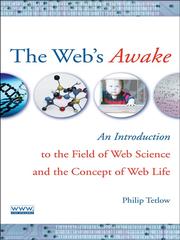
Understanding information and computation
Philip Tetlow · 2016
Where to buy
Amazon’s price changes daily, so the most accurate place to see it is there, at the moment you buy.
View on AmazonThis is an affiliate link: if you buy through it, the site earns a small commission at no extra cost to you, which helps us bring quality content and maintain the site. As an Amazon Associate we earn from qualifying purchases.
About the book
The World Wide Web is truly astounding. It has changed the way we interact, learn and innovate. It is the largest sociotechnical system humankind has created and is advancing at a pace that leaves most in awe. It is an unavoidable fact that the future of the world is now inextricably linked to the future of the Web. Almost every day it appears to change, to get better and increase its hold on us. For all this we are starting to see underlying stability emerge. The way that Web sites rank in terms of popularity, for example, appears to follow laws with which we are familiar. What is fascinating is that these laws were first discovered, not in fields like computer science or information technology, but in what we regard as more fundamental disciplines like biology, physics and mathematics. Consequently the Web, although synthetic at its surface, seems to be quite 'natural' deeper down, and one of the driving aims of the new field of Web Science is to discover how far down such 'naturalness' goes. If the Web is natural to its core, that raises some fundamental questions. It forces us, for example, to ask if the central properties of the Web might be more elemental than the truths we cling to from our understandings of the physical world. In essence, it demands that we question the very nature of information. "Understanding Information and Computation" is about such questions and one possible route to potentially mind-blowing answers.
Book details
- Year
- 2016
- Language
- English
- Publisher
- Taylor & Francis Group
- Editions
- 7
- Pages
- 408
- ISBN
- 9781317004820
Data source: Wikidata