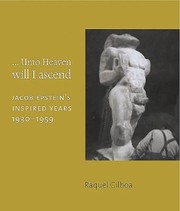
Unto Heaven Will I Ascend
Raquel Gilboa · 2013
Where to buy
Amazon’s price changes daily, so the most accurate place to see it is there, at the moment you buy.
View on AmazonAbout the book
As an American living in England, a conscious Jew who utilized Christian symbols, a skillful modeler who introduced direct carving into England, and a modernist who eventually came to dislike abstraction for its own sake, Epstein did not fit neatly into the artistic categories of his time. Apart from his still widely admired naturalistic bronze portraits, Epstein's oeuvre remains poorly understood and his reputation is dominated by his famous Rock Drill from before World War I. As this book shows, Epstein remained an avant-garde artist throughout his life, even if he ignored modernist dogma as well as man-in-the-street prudery. Gilboa's text reveals the man in all his genius, interpreting many works in the light of Epstein's personal circumstances. In an atmosphere of polarized attitudes to art and polite anti-Semitism at the end of the 1920s growing rather less polite thereafter, the outsider Jew Epstein deliberately became estranged from London's art world. He responded to society's attitude towards him in a series of bold projects -- the monumental 'Genesis' (1930) and 'Primeval Gods' (1931-32); the smaller carvings 'Chimera and Elemental' (1932); 'Behold the Man' (1934-35); 'Consummatum Est' (1938-39); 'Adam' (1938) and 'Jacob and the Angel' (1940); the bronze 'Lucifer '(1944-45) and again a carving, 'Lazarus' (1947). One cannot ignore the symbolic names of these sculptures. The discussion in this book will reveal that in each case the name has a definite relation to the sculpture's theme and essence, as well as to the personal concerns of the sculptor.
Book details
- Year
- 2013
- Language
- English
- Publisher
- Paul Holberton Publishing
- Editions
- 1
- Pages
- 252
- ISBN
- 9781907372490
Data source: Wikidata