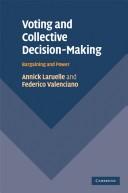
Voting and collective decision-making
Annick Laruelle, Federico Valenciano · 2011
Where to buy
Amazon’s price changes daily, so the most accurate place to see it is there, at the moment you buy.
View on AmazonThis is an affiliate link: if you buy through it, the site earns a small commission at no extra cost to you, which helps us bring quality content and maintain the site. As an Amazon Associate we earn from qualifying purchases.
About the book
Every day thousands of decisions are made by all kinds of committees, parliaments, councils and boards by a "yes-no" voting process. Sometimes a committee can only accept or reject the proposals submitted to it for a decision. On other occasions, committee members have the possibility of modifying the proposal and bargaining an agreement prior to the vote. In either case, what rule should be used if each member acts on behalf of a different sized group? It seems intuitively clear that if the groups are of different sizes then a symmetric rule (e.g. the simple majority or unanimity) is not suitable. The question then arises of what voting rule should be used. Voting and Collective Decision-Making addresses this and other issues through a study of the theory of bargaining and voting power, showing how it applies to real decision-making contexts.
Book details
- Year
- 2011
- Language
- English
- Publisher
- University of Cambridge ESOL Examinations
- Editions
- 9
- Pages
- 204
- ISBN
- 9780521182638
Data source: Wikidata