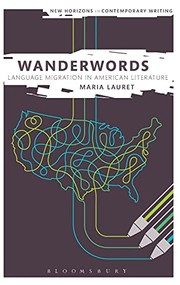
Wanderwords
Maria Lauret · 2014
Where to buy
Check today’s price on Amazon. We do not show prices because they change daily.
View on AmazonAffiliate link. As an Amazon Associate we earn from qualifying purchases.
About the book
"How do (im)migrant writers negotiate their representation of a multilingual world for a monolingual audience? Does their English betray the presence of another language, is that other language erased, or does it appear here and there, on special occasions for special reasons? Do words and meanings wander from one language and one self to another? Do the psychic and cultural worlds of different languages split apart or merge? What is the aesthetic effect of such wandering, splitting, or merging? Usually described as "code-switches" by linguists, fragments of other languages have wandered into American literature in English from the beginning. Wanderwords asks what, in the memoirs, poems, essays, and fiction of a variety of twentieth and twenty first century writers, the function and meaning of such language migration might be. It shows what there is to be gained if we learn to read migrant writing with an eye, and an ear, for linguistic difference and it concludes that, freighted with the other-cultural meanings wrapped up in their different looks and sounds, wanderwords can perform wonders of poetic signification as well as cultural critique. Bringing together literary and cultural theory with linguistics as well as the theory and history of migration, and with psychoanalysis for its understanding of the multilingual unconscious, Wanderwords engages closely with the work of well-known and unheard-of writers such as Mary Antin and Eva Hoffman, Richard Rodriguez and Junot Di;az, Theresa Hak Kyung Cha and Bharati Mukherjee, Edward Bok and Truus van Bruinessen, Susana Chávez-Silverman and Gustavo Perez-Firmat, Pietro DiDonato and Don DeLillo. In so doing, a poetics of multilingualism unfolds that stretches well beyond translation into the lingual contact zone of English-with-other-languages that is American literature, belatedly re-connecting with the world"-- "Post-poststructuralism and psychoanalysis, and in an era of global migration in which English is the lingua franca but not necessarily the lingua aesthetica for migrants, readers and critics are more aware than ever that words and meanings wander, that writers cannot be taken at their word, and that the borders between literary forms (fiction, poetry, life-writing, essays) often do not hold. What happens, then, with writers who work in English but have more than one language at their disposal? Do their words wander from one language, one life, one self, one literary form to another; do the psychic and
Book details
- Year
- 2014
- Language
- English
- Series
- New Horizons in Contemporary Writing
- Publisher
- Bloomsbury
- Editions
- 2
- Pages
- 330
- ISBN
- 9781628921632
Data source: Wikidata