Wavelet Theory and Its Applications
Randy K. Young · 1993
Where to buy
Amazon’s price changes daily, so the most accurate place to see it is there, at the moment you buy.
View on AmazonThis is an affiliate link: if you buy through it, the site earns a small commission at no extra cost to you, which helps us bring quality content and maintain the site. As an Amazon Associate we earn from qualifying purchases.
About the book
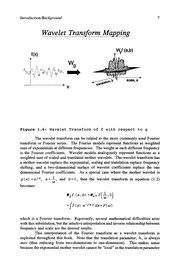
This book reviews, extends, and applies wavelet theory, concentrating on the practical applications. Many pictures provide visualizations of wavelet theory and its new extentions, as well as relationships to established concepts. Wavelet theory is integrated with other general theories, including linear systems theory and template matching or matched filtering. These relationships create analogies with related research and connections to practical applications. In addition, by demonstrating the effectiveness of wavelet theory in these general applications, many other specific applications may be improved. Temporal and spatial signals and systems are considered. The properties of the wavelet transform representation are sensitive to the chosen mother wavelet (the kernel of the wavelet transform, analogous to the exponential function in a Fourier transform). These properties are examined and techniques for analyzing these sensitivities are presented. Wavelet theory is extended with the new mother mapper operator that efficiently maps a wavelet transform with respect to one mother wavelet to a new wavelet transform with respect to a different mother wavelet. The mother mapper efficiently calculates concise wavelet representations that utilize multiple mother wavelets. The mother mapper operator is also employed to efficiently compute 'cross' wavelet transforms or wideband cross ambiguity functions; these 'cross' operators extract the 'commonalities' between two signals or systems to determine the existence or structure of these commonalities. An original system model, the space-time varying (STV) wavelet operator, is constructed with wavelet theory. As a special case, the STV model can represent linear time-invariant (LTI) systems. LTI systems are represented by the one-dimensional (1D) impulse response. This one-dimensional impulse response is the center slice of the two-dimensional (2D) STV representation. Both the LTI and STV models can also be made to vary with time (leading to 2D and 3D models, respectively). The advantages of the new STV model are expolited to characterize or image an environment. Physically, the STV wavelet operator creates an output by summing weighted, scaled and translated replicas of the input; these weights are the new system model. This is analogous to the LTI system model in which the output is a weighed sum of translated replicas of the input signal; with the weights being the LTI system model, the impulse response. Obviously,
Book details
- Year
- 1993
- Language
- English
- Series
- The Springer International Series in Engineering and Computer Science, VLSI, Computer Architecture and Digital Signal Pr
- Publisher
- Springer US
- Editions
- 1
- Pages
- 223
- ISBN
- 9781461365938
Data source: Wikidata