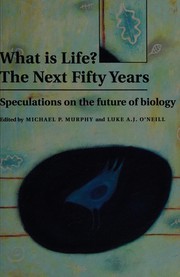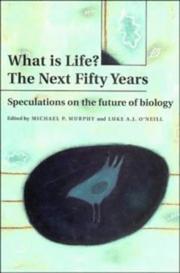
What is life?
Luke A. J. O'Neill · 1995
Where to buy
Amazon’s price changes daily, so the most accurate place to see it is there, at the moment you buy.
View on AmazonThis is an affiliate link: if you buy through it, the site earns a small commission at no extra cost to you, which helps us bring quality content and maintain the site. As an Amazon Associate we earn from qualifying purchases.
About the book
"Erwin Schrödinger's book What is Life?, which was originally delivered as a set of lectures at Trinity College, Dublin, is perhaps one of the most important scientific books of the twentieth century. It marked the beginning of molecular biology, and stimulated scientists such as Watson and Crick to explore and discover the structure of DNA. The novelty and appeal of What is Life? is that Schrödinger addressed the central problems of biology--heredity and how organisms use energy to maintain order--from a physicist's perspective. Fifty years later, at Trinity College, a number of outstanding scientists from a range of disciplines gathered to celebrate the anniversary of Schrödinger's lectures. In this book, they present their views on the current main problems in biology. The contributors are eminent scientists (including two Nobel Laureates) and well-known writers of popular science, including Jared Diamond, Christien de Duve, Manfred Eigen, Stephen Jay Gould, Stuart Kauffman, John Maynard Smith, Roger Penrose, and Lewis Wolpert. They tackle questions on our current understanding of the origin of life, evolution, the origin of human inventiveness, developmental biology, and the basis for consciousness. The book ends with a touching biography by Schrödinger's daughter, Ruth Braunizer. This book will set the stage for biological research into the next century and is essential reading for anyone interested in biology and its future." -- Publisher's website.
Book details
- Year
- 1995
- Language
- English
- Publisher
- Cambridge University Press
- Editions
- 1
- Pages
- 203
- ISBN
- 9780521455091
Data source: Wikidata
More by Luke A. J. O'Neill