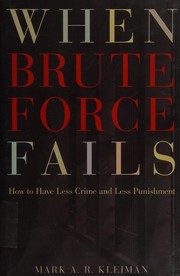
When brute force fails
Mark Kleiman · 2009
Where to buy
Check today’s price on Amazon. We do not show prices because they change daily.
View on AmazonAffiliate link. As an Amazon Associate we earn from qualifying purchases.
About the book
Since the crime explosion of the 1960s, the prison population in the United States has multiplied fivefold, to one prisoner for every hundred adults, a rate unprecedented in American history and unmatched anywhere in the world. Even as the prisoner head count continues to rise, crime has stopped falling, and poor people and minorities still bear the brunt of both crime and punishment. This work explains how we got into the current trap and how we can get out of it: to cut both crime and the prison population in half within a decade. The author demonstrates that simply locking up more people for lengthier terms is no longer a workable crime-control strategy. But, he says, there has been a revolution, largely unnoticed by the press, in controlling crime by means other than brute-force incarceration: substituting swiftness and certainty of punishment for randomized severity, concentrating enforcement resources rather than dispersing them, communicating specific threats of punishment to specific offenders, and enforcing probation and parole conditions to make community corrections a genuine alternative to incarceration. As the author shows, "zero tolerance" is nonsense: there are always more offenses than there is punishment capacity. But, it is possible and essential to create focused zero tolerance, by clearly specifying the rules and then delivering the promised sanctions every time the rules are broken. Brute-force crime control has been a costly mistake, both socially and financially. Now that we know how to do better, according to the author, it would be immoral not to put that knowledge to work.
Book details
- Year
- 2009
- Language
- English
- Publisher
- Princeton University Press
- Editions
- 1
- Pages
- 231
- ISBN
- 9780691142081
Data source: Wikidata
More by Mark Kleiman