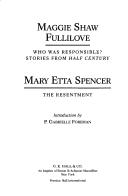
Who was responsible?
Where to buy
Amazon’s price changes daily, so the most accurate place to see it is there, at the moment you buy.
View on AmazonThis is an affiliate link: if you buy through it, the site earns a small commission at no extra cost to you, which helps us bring quality content and maintain the site. As an Amazon Associate we earn from qualifying purchases.
About the book
In her novel Who Was Responsible? (1919), Maggie Shaw Fullilove links temperance activism to a strong feminist vision. Like Frances Harper's recently rediscovered novel Sowing and Reaping: A Temperance Tale, this work has as its central themes women's security within marriage and their rights as moral and political reformists. Both Harper and Shaw Fullilove also use racially indeterminate characters. This strategy shields black men from charges of inherited tendencies toward dissipation and barbarism in an era when theories of degeneration were used to justify lynchings and systematic disenfranchisement. The four stories contained in the present volume, originally published from 1917 to 1918 in the African-American journal the Half Century, examine the connections and tensions among the issues of temperance, economic development, women's rights, and domesticity. . Mary Etta Spencer's novel The Resentment (1921) is a racial rags to riches tale that supports Booker T. Washington's urging of black Southerners to "cast down your buckets where you are." Its hero is an African-American Horatio Alger, who, despite adversity, succeeds as a Southern farmer and garners the support of his white and black neighbors.
Book details
- Year
- 1919
- Language
- English
- Publisher
- G. K. Hall & Company
- Editions
- 1
- Pages
- 462
- ISBN
- 9780816116300
Data source: Wikidata