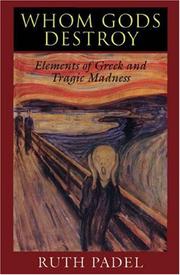
Whom gods destroy
Ruth Padel · 1995
Where to buy
Amazon’s price changes daily, so the most accurate place to see it is there, at the moment you buy.
View on AmazonThis is an affiliate link: if you buy through it, the site earns a small commission at no extra cost to you, which helps us bring quality content and maintain the site. As an Amazon Associate we earn from qualifying purchases.
About the book
Madness is central to Western tragedy in all epochs, but we find the origins of this centrality in early Greece: in Homeric insight into the "damage a damaged mind can do." Greece, and especially tragedy, gave the West its permanent perception of madness as violent and damaging. Drawing on her deep knowledge of anthropology, psychoanalysis, Shakespeare, and the history of madness, as well as of Greek language and literature, Ruth Padel probes the Greek language of madness, which is fundamental to tragedy: translating, making it reader-friendly to nonspecialists, and showing how Greek images continued through medieval and Renaissance societies into a "rough tragic grammar" of madness in the modern period. This intensely poetic and solidly argued book is a rare source of "knowledge that it is sad to have to know." It focuses on the problematic relation of madness and God, discussing en route such topics as the double bind, black bile and melancholy, the Derrida-Foucault debate on writing (about) madness, Christian folly, "fine frenzy," shamanism, psychoanalysts on tragedy, St. Paul on God's "hardening the heart," links between madness and murder, pollution and syphilis, and the Irish for "mad."
Book details
- Year
- 1995
- Language
- English
- Publisher
- Princeton University Press
- Editions
- 1
- Pages
- 296
- ISBN
- 9780691025889
Data source: Wikidata
More by Ruth Padel