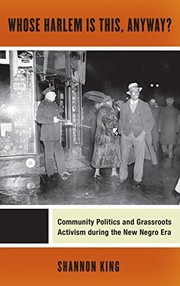
Whose Harlem Is This, Anyway?
Shannon King · 2015
Where to buy
Amazon’s price changes daily, so the most accurate place to see it is there, at the moment you buy.
View on AmazonThis is an affiliate link: if you buy through it, the site earns a small commission at no extra cost to you, which helps us bring quality content and maintain the site. As an Amazon Associate we earn from qualifying purchases.
About the book
The Harlem of the early twentieth century was more than just the stage upon which black intellectuals, poets and novelists, and painters and jazz musicians created the New Negro Renaissance. It was also a community of working people and black institutions who combated the daily and structural manifestations of racial, class, and gender inequality within Harlem and across the city. New Negro activists, such as Hubert Harrison and Frank Crosswaith, challenged local forms of economic and racial inequality. Insurgent stay-at-home black mothers took negligent landlords to court, complaining to magistrates about the absence of hot water and heat in their apartment buildings. Black men and women, propelling dishes, bricks, and other makeshift weapons from their apartment windows and their rooftops, retaliated against hostile policemen harassing blacks on the streets of Harlem. From the turn of the twentieth century to the Great Depression, black Harlemites mobilized around local issues -- such as high rents, jobs, leisure, and police brutality -- to make their neighborhood an autonomous black community. In this book, Shannon King argues that Harlemite's mobilization for community rights raised the black community's racial consciousness and established Harlem's political culture. By the end of the 1920s, Harlem had experienced a labor strike, a tenant campaign for affordable rents, and its first race riot. These public forms of protest and discontent represented the dress rehearsal for black mass mobilization in the 1930s and 1940s. By studying blacks' investment in community politics, King makes visible the hidden stirrings of a social movement deeply invested in a Black Harlem.
Book details
- Year
- 2015
- Language
- English
- Publisher
- NYU Press
- Editions
- 3
- Pages
- 272
- ISBN
- 9781479811274
Data source: Wikidata
More by Shannon King