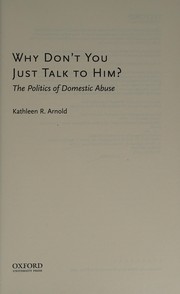
Why Don't You Just Talk to Him?
Kathleen R. Arnold · 2015
Where to buy
Amazon’s price changes daily, so the most accurate place to see it is there, at the moment you buy.
View on AmazonAbout the book
This study examines the broad political contexts in which violence, specifically domestic violence, occurs. The author argues that liberal and Enlightenment notions of the social contract, rationality, and egalitarianism--the ideas that constitute norms of good citizenship--are inextricably linked to violence. According to this dynamic, targets of abuse are viewed as being irrational, incapable of making good choices or negotiating with their abusers, or otherwise violating norms of the social contract; they are, in other words, second-class citizens. In fact, as the author shows, drawing from Nietzsche and Foucault's theories of power and aruging against much of the standard literature on domestic violence, the very mechanisms that purportedly help targets of domestic abuse actually work to compound the problem by exacerbating (or ignoring) the power differences between the abuser and the abused. The key to preventing domestic violence, the author contends, lies in seeing it as a political rather than a personal issue that has political consequences. Enlightenment ideas about intimacy that conceive of personal relationships as mutual, equal, and contractual must be challenged, as well as policy ideas that suggest targets of abuse can simply choose to leave abusive relationships without other personal or economic consequences.--From publisher description.
Book details
- Year
- 2015
- Language
- English
- Publisher
- Oxford University Press, Incorporated
- Editions
- 1
- Pages
- 272
- ISBN
- 9780190262280
Data source: Wikidata
More by Kathleen R. Arnold