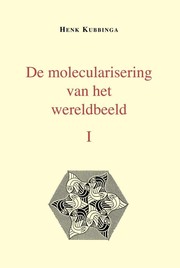
De molecularisering van het wereldbeeld
Henk Kubbinga · 2003
על הספר
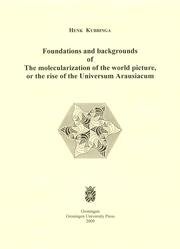
*De molecularisering van het wereldbeeld* describes in two volumes the rise and development of the concept of molecule in the natural sciences and the life sciences, and so against the background of the Epicurus and Lucretius' neo-atomism. It is a thoroughgoing monograph indeed, because there is also a lot of mathematics and natural philosophy at stake. Of course, typically Dutch details are highlighted (terminology, curiosities, and the like). The first volume (2003) assesses, in three chapters, for the sciences under consideration the period up to 1800. There follow separate chapters on the developments in physics and chemistry between ca. 1800 and ca. 1900. The concept of molecule appears to be *produce of Holland*. It was invented by the Zealander Isaac Beeckman (1588-1637). In much the same way that Lucretius is called the *Epicurus romanus*, Beeckman may be nicknamed the *Epicurus batavus*. Beeckman developed a *discrete* picture of nature, in which the molecular theory featured central stage, with a taylor-made mathematics to support the consequences. At the end of the 18th century that molecular theory had grown into *molecularism*, that is, a real 'Theory of everything'. Unsurprisingly, 19th century's physics and chemistry were primarily *molecular*-minded. The second volume (2005) describes, in its first chapters, the 19th century's developments in the life sciences, on the one hand, and in crystallography and mineralogy, on the other. Biology emancipates itself from medical science, crystallography from mineralogy. A separate chapter is devoted to the rise of the modern system of units, the so-called *Système international [..]*, with special attention for the molecular aspects. For the period up to 1925-1940 the developments are followed in detail. For the later period we content ourselves with an impression based on some 12 Nobel Prizes. The last chapter is an epilog, in which the new insights are checked against the historic and historiographical facts. There are, moreover, a bibliography and indexes of names and subjects. The message is clear: we have been living the breakthrough of a new *picture of the world*. This picture has been called after the House of Orange: *Universum Arausiacum*. The book is dedicated to the memory of Prince Claus of the Netherlands.
פרטי הספר
- שנה
- 2003
- הוצאה
- Verloren
- מהדורות
- 1
- עמודים
- 1078
- ISBN
- 9789065507329
מקור הנתונים: Wikidata
עוד של Henk Kubbinga