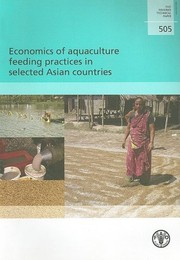
Economics of Aquaculture Feeding Practices in Selected Asian Countries (FAO Fisheries and Aquaculture Technical Papers)
Food and Agriculture Organization of the United Nations · 2007
על הספר
This technical paper provides an analysis of the economic implications of, and the reasons for, adopting various feeding practices for different fish species and aquaculture systems in Asia. It comprises of six selected country case study reports from Asia (Bangladesh, China, India, the Philippines, Thailand and Viet Nam) and an overall synthesis ending with conclusions and recommendations. Field survey for the case studies was carried out between 15 October 2005 and 14 February 2006 and three hundred and fourty Asian fish farmers were interviewed about their fish feeding practices. In India and China selected farmers were engaged in carp polyculture, in Bangladesh and Viet Nam they raised sutchi catfish (Pangasianodon hypophthalmus) and pangasiid catfish (Pangasianodon hypophthalmus and Pangasius bocourti) respectively, in Thailand hybrid catfish (Clarias gariepinus x C. macrocephalus).^ In the Philippines those undertaking polyculture of giant freshwater prawn and milkfish participated. Prior to the random selection of farmers each national group of farmers had been stratified according to three broad categories of feeding practices. These were (i) use of industrially produced pelleted feed (intensive farmers), (ii) use of industrial and farm-made feed mixes (semi-intensive), and (iii) use of on-farm feeds consisting of a mixture of locally available feed ingredients (traditional/ extensive). The 340 respondents represent these three feeding categories in about equal proportions, and include 60 farmers by country with the exception of India in which 40 farmers were interviewed. After completion of the field survey and the preliminary analyses, the researchers involved in the case studies met to agree on methods and an outline for country reports.^ After agreeing on the methodology and outline of the country reports, the authors of the case studies, for each feeding strategy and farming system, analyzed demographic factors (including age and marital status, education and ownership structure), physical characteristics (average number of ponds and average pond size), and other input features (stocking strategies, feeding practices, types of feed, frequency and intensity of feeding and labour utilization). The case studies also identified the principal input costs, assessed the economic rates of return (gross and net margins), returns to labour, land and capital, gross and net total factor productivity, break-even prices and production and returns on capital
פרטי הספר
- שנה
- 2007
- שפה
- English
- הוצאה
- FAO
- מהדורות
- 1
- עמודים
- 216
- ISBN
- 9789251058749
מקור הנתונים: Wikidata
עוד של Food and Agriculture Organization of the United Nations