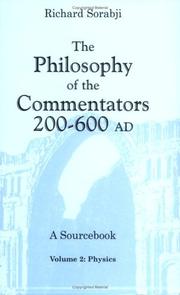
The Philosophy of the Commentators, 200-600 AD
Richard Sorabji · 2003
על הספר
"This is a sourcebook that draws upon the 400 years of transition from ancient Greek philosophy to the medieval philosophy of Islam and the West. Philosophy was then often written in the form of commentaries on the works of Plato and Aristotle. Many ideas wrongly credited to the Middle Ages derive from this period, e.g. that of impetus in dynamics and intentional objects in philosophy of mind. The later Neoplatonist commentators fought a losing battle with Christianity, but inadvertently made Aristotle acceptable to Christians by ascribing to him belief in a Creator God and human immortality. They also provided a panorama of up to 1000 years of preceding Greek philosophy, much of it otherwise lost. They serve as the missing link essential for understanding the history of Western philosophy. Psychology was for the Neoplatonist commentators the gateway to metaphysics and theology. It was the subject on which Plato and Aristotle disagreed most, and the subject on which the commentators went furthest beyond them in their search for an amalgamation. Ethics and religious practice fall naturally under psychology and are included in this volume. All sources appear in English translation and are carefully linked and cross-referenced by editorial comment and explanation."--Bloomsbury Publishing This is a sourcebook that draws upon the 400 years of transition from ancient Greek philosophy to the medieval philosophy of Islam and the West. Philosophy was then often written in the form of commentaries on the works of Plato and Aristotle. Many ideas wrongly credited to the Middle Ages derive from this period, e.g. that of impetus in dynamics and intentional objects in philosophy of mind. The later Neoplatonist commentators fought a losing battle with Christianity, but inadvertently made Aristotle acceptable to Christians by ascribing to him belief in a Creator God and human immortality. They also provided a panorama of up to 1000 years of preceding Greek philosophy, much of it otherwise lost. They serve as the missing link essential for understanding the history of Western philosophy. This volume covers three main areas of study. First, the metaphysics of Aristotle's logical works: the concepts of universal and particular underwent surprising transformations in this period, which explain later medieval views, and which gave rise to debates, still raging today, on personal survival after an interruption such as death.Secondly, logic in a more conventional sense: the most
המשפט הראשון: Nature (phusis) is the subject of Aristotle's Physics, and so is placed first.
פרטי הספר
- שנה
- 2003
- שפה
- English
- הוצאה
- Cornell University Press
- מהדורות
- 5
- עמודים
- 401
- ISBN
- 9780801489884
מקור הנתונים: Wikidata
עוד של Richard Sorabji