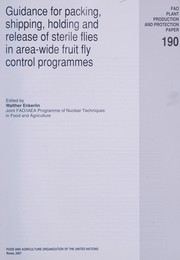
Guidance for packing, shipping, holding and release of sterile flies in area-wide fruit fly control programmes
Food and Agriculture Organization of the United Nations · 2007
Where to buy
Amazon’s price changes daily, so the most accurate place to see it is there, at the moment you buy.
View on AmazonAbout the book
The International Plant Protection Convention (IPPC) is the international treaty under which the International Standards for Phytosanitary Measures (ISPM) are adopted. ISPMs enable the development of technically justified measures for imported plants and plant products, and are intended to harmonize phytosanitary measures applied in international trade. These standards are the accepted reference under the World Trade Organization (WTO) Agreement on Sanitary and Phytosanitary Measures (SPS Agreement). The use and transboundary shipment of sterile insects was not part of ISPM No. 3, "Code of Conduct for the Import and Release of Exotic Biological Control Agents" adopted in 1995, because biological control agents had been defined as self-replicating organisms. Since the implementation of the Sterile Insect Technique (SIT) has largely been dominated by the public sector, this did not represent a problem for the transboundary shipment of sterile insects. However, the lack of regulatory framework did discourage private investment in the production and shipment of sterile insects.Over the last three years (2002-2005) ISPM No. 3 has undergone a major revision to update and broaden its scope. In particular, we have been involved in explicitly including sterile insects as beneficials in the revised standard. The revised ISPM No.3 "Guidelines for the Export, Shipment, Import, and Release of Biological Control Agents and Other Beneficial Organisms" was drafted in 2004 and submitted for country consultation. The revised ISPM No. 3 was adopted by the governing body of the IPPC, the Interim Commission for Phytosanitary Measures (ICPM), in April 2005 at FAO headquarters in Rome. Thus sterile insects are considered in parallel to other beneficial organisms by the IPPC through the adoption of the revised ISPM No. 3 and this should facilitate their use, especially in terms of commercialization of the SIT and international trade of sterile insects.--Publisher's description.
Book details
- Year
- 2007
- Language
- English
- Series
- FAO plant production and protection paper -- 190
- Publisher
- Food and Agriculture Organization of the United Nations
- Editions
- 1
- Pages
- 134
- ISBN
- 9789251057599
Data source: Wikidata
More by Food and Agriculture Organization of the United Nations