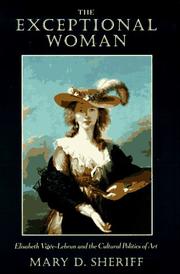
The exceptional woman
Mary D. Sheriff · 1996
Where to buy
Amazon’s price changes daily, so the most accurate place to see it is there, at the moment you buy.
View on AmazonAbout the book
Elisabeth Vigee-Lebrun (1755-1842) was an enormously successful painter, a favorite portraitist of Marie-Antoinette, and one of the few women accepted into the Royal Academy of Painting and Sculpture. In her role as an artist, she was simultaneously flattered as a charming woman and vilified as monstrously unfeminine. In the Exceptional Woman, Mary D. Sheriff uses Vigee-Lebrun's career to explore the contradictory position of "woman-artist" in the moral, philosophical, professional, and medical debates about women in eighteenth-century France. Central to Sheriff's analysis is one key question: given the cultural norms and social attitudes that regulated a woman's activities, how could Vigee-Lebrun conceive of herself as an artist, and indeed become a successful one, in old-regime France. Paying particular attention to painted and textual self-portraits, Sheriff shows how Vigee-Lebrun's images and memoirs undermined the assumptions about "woman" and the strictures imposed on women. Engaging ancien-regime philosophy as well as modern feminism, psychoanalysis, literary theory, and art criticism, Sheriff's interpretations of Vigee-Lebrun's paintings challenge us to rethink the work of this controversial woman artist.
First sentence: In the Summer of 1792, Elisabeth Vigee-Lebrun visited the cabinet of Felice Fortana, the celebrated Florentine anatomist and maker of wax anatomical models.
Book details
- Year
- 1996
- Language
- English
- Publisher
- University Of Chicago Press
- Editions
- 1
- Pages
- 368
- ISBN
- 9780226752822
Data source: Wikidata
More by Mary D. Sheriff