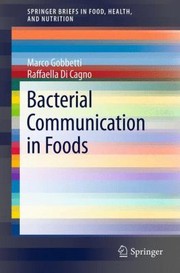
Bacterial Communication In Foods
Marco Gobbetti · 2012
על הספר
It is generally assumed that microorganisms synthesize, release, detect and respond to small signaling hormone-like molecules. These molecules are used for a process termed “quorum sensing” (QS), a phenomenon that enables bacteria to sense when the minimal number of cells, or “quorum,” is achieved for a concerted response to be initiated. Words such as “language” and “behavior” are frequently used to depict QS in the literature. More simply put, language and cross-talk between bacteria, and between bacteria and animal or plant hosts, determines the behavior (e.g., beneficial or pathogenic effects) of bacteria. Currently, the major concern is to understand and decode this language. Overall, bacterial cross-talk was mainly studied on environmental, plant, and human pathogenic bacteria. Few studies considered food-related lactic acid bacteria. The cross-talk between bacteria influences the behavior and, in turn, the environmental adaptation and phenotypes. Therefore, it is understood that bacterial cross-talk has important applicative repercussions. The language spoken between bacteria populating the same food ecosystem may condition the phenotypic traits of starter lactic acid bacteria and, consequently, their performance. This Brief aims to define the basis of cell-to-cell signalling in food fermentation and will highlight: (i) microbiology, nutritional, chemical and functional aspects; (ii) functional properties due to microbial adaptation to the gastrointestinal tract; (iii) principal phenotypes under control of QS circuitries; (iv) quorum quenching. This Brief will be the first reference on this topic and it will highlight the main results for a more productive industrial application. Draft content 1. Signals of food related Gram-negative and Gram-positive bacteria The chapter will describe the different signaling languages used by Gram-negative bacteria (N-acyl-L-homoserine lactones) and Gram-positive bacteria (based on the synthesis of post-translationally modified peptides) and the universal chemical lexicon, shared by both Gram-positive and -negative bacteria (autoinducer-2 through the activity of the LuxS enzyme). 2. Phenotypes related to quorum sensing The chapter will describe the bacterial phenotypes, such as virulence, biofilm maturation, bacteriocin synthesis, and secondary metabolite production under control of QS circuitries. 3. Cell-to-cell signalling in fermented food: sourdough The chapter will describe the language spoken between bacteria
פרטי הספר
- שנה
- 2012
- שפה
- English
- הוצאה
- Springer London, Limited
- מהדורות
- 3
- ISBN
- 9781461456568
מקור הנתונים: Wikidata